
Collector research guide
How to evaluate digital artists before buying.
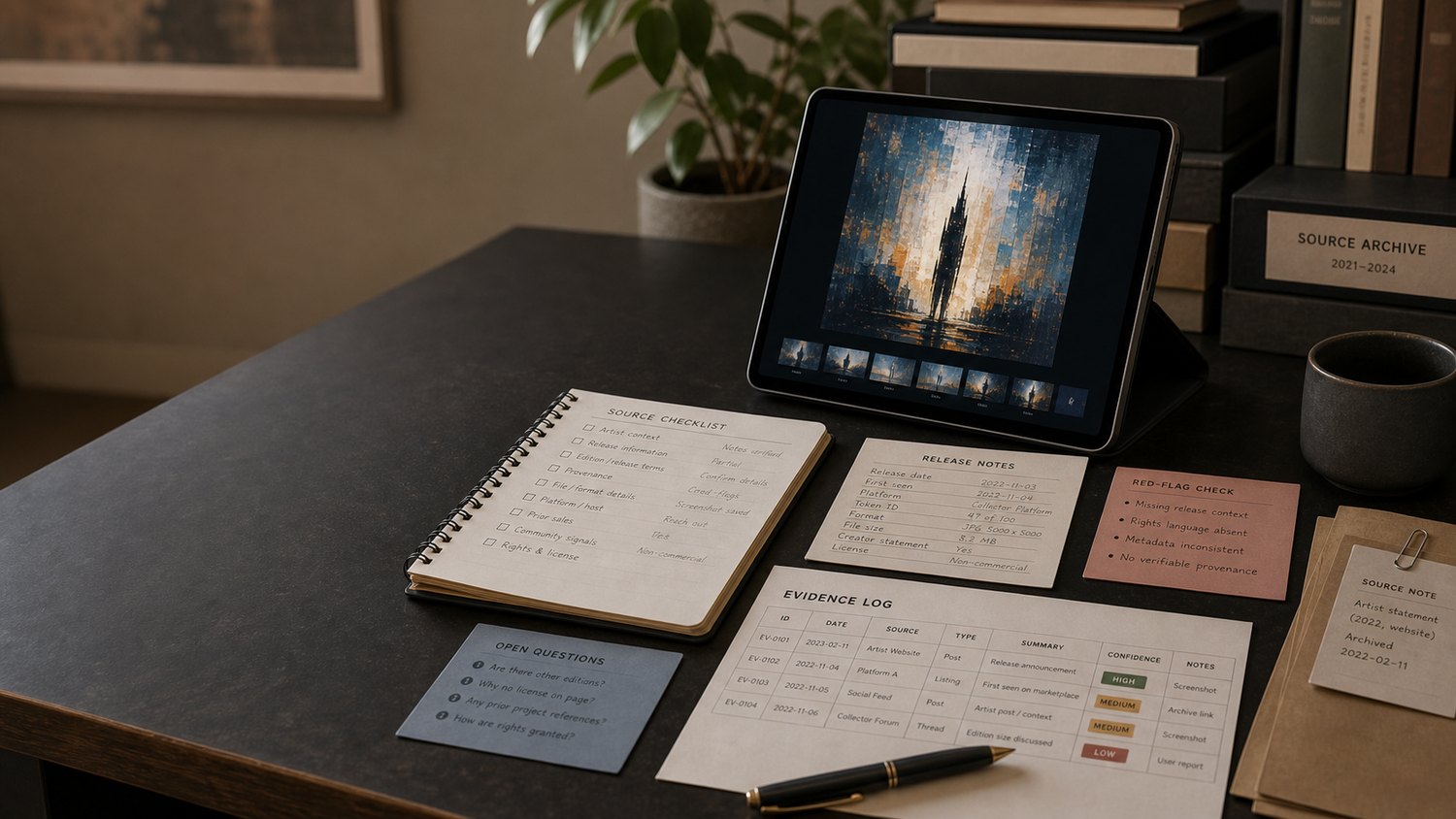
Build a source file that separates evidence, interpretation, uncertainty, and professional-review questions before making your own collecting decision.
Read guide
No advice
Article
Start with sources, not excitement.
Digital art can be difficult to research because evidence is often scattered across an artist website, marketplace listing, platform page, contract reference, social post, interview, community note, or metadata panel. The practical question is not whether a listing feels convincing. The practical question is what can be documented from available sources and what remains uncertain.
Use the workflow below to build a calm research file before making your own collecting decision.
1. Verify artist identity and official sources
Start with official or near-official sources: artist site, portfolio, verified social profile, platform page, gallery or institution page, interviews, essays, prior releases, and contract or collection references linked from those sources.
- Can the artist or pseudonymous history be traced through credible public sources?
- Do official links point consistently to the same platform pages and collection records?
- Are important claims repeated by independent sources, or only by a seller or listing?
2. Study the work before the market
Look at the medium, process, series context, edition format, display assumptions, and platform dependencies before focusing on price, sales, bids, or collector attention.
3. Review release history and supply mechanics
Document prior drops, edition size, mint mechanics, burn or claim rules, collaborations, platform-led releases, supply changes, and public communication around delays or technical changes. A low edition size is not a conclusion by itself. It is one field in the research file.
4. Separate evidence from interpretation
Evidence is what a source directly appears to show. Interpretation is what you think that evidence may mean. Uncertainty is what the evidence does not show. A useful file keeps those three layers visible.
5. Record red flags as questions, not verdicts
Missing source context, inconsistent descriptions, unclear rights language, platform dependencies, deleted pages, or fragile metadata should become dated rows in a research file. They should not be softened into certainty or exaggerated into unsupported findings.
6. Write a one-page collector note
End with a short note that names the artwork, source trail, what is visible, what is unclear, which questions remain open, and which topics require professional review outside Veylaris.
Compare the workflow with Veylaris proof routes.
Review the sample report and methodology pages before emailing. If the question fits, use the contact route with public links and no sensitive files.
This guide is educational research workflow material. It helps organize sources, uncertainty, and professional-review questions; it does not provide financial, investment, legal, tax, security, appraisal, authenticity, fraud, custody, or purchase-safety advice.
Editorial research
Collector guides should look like source work, not generic advice.
Articles should lead readers toward sample reports, methodology, and contact only when they have a focused source question.

Research cards, artwork references, and checklist structure support educational copy while keeping the article path focused on public proof routes.

The editorial path starts from source uncertainty and points back to proof routes rather than unsupported buying advice.